How to Identify Minerals: Seven Tests Every Collector Should Know
To identify minerals, you test physical properties — hardness, streak, luster, cleavage, crystal habit, and specific gravity — and match the results against known values. Color helps, but it lies more often than any other clue. This guide walks you through all seven diagnostic tests, gives quick ID profiles for the ten minerals you're most likely to find, and shows how a photo-based mineral identifier like the free Rockhound app fits into the workflow. Most common minerals can be named in under five minutes with nothing more than a fingernail, a coin, a knife, and a piece of unglazed porcelain.
Mineral vs. rock: know what you're testing
A mineral is a naturally occurring, inorganic solid with a definite chemical composition and an ordered crystal structure. Quartz is always SiO2. Calcite is always CaCO3. That consistency is what makes mineral identification possible — every piece of calcite on Earth scratches at hardness 3 and fizzes in vinegar.
A rock, by contrast, is an aggregate of one or more minerals. Granite is a jumble of quartz, feldspar, and mica; limestone is mostly calcite grains cemented together. When you test a rock, you're really testing whichever mineral grain your tool happens to hit — which is why results on rocks can seem inconsistent. If your specimen looks like a mixed-grain mass rather than a single uniform material, start with our guide to identifying rocks instead. If it's one consistent substance — a single crystal, a uniform vein chunk, a cleaved fragment — you're identifying a mineral, and you're in the right place.
The seven diagnostic properties
Geologists lean on the same short list of properties they've used for two centuries, because these properties are consistent, testable in the field, and hard to fake. Run them roughly in this order.
1. Hardness (Mohs scale)
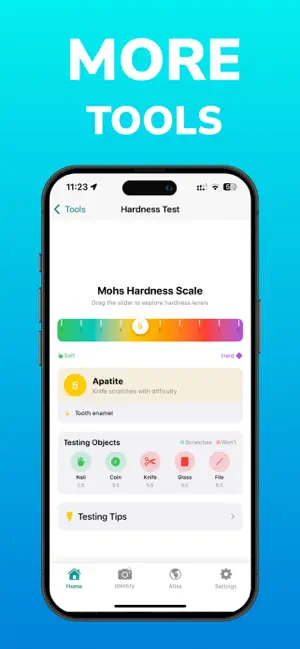
Hardness — resistance to scratching — is the single most useful field test. The Mohs hardness scale runs from 1 (talc) to 10 (diamond), and everyday objects bracket your specimen neatly: a fingernail is about 2.5, a copper coin 3.5, a steel knife blade or glass about 5.5, and a hardened steel file 6.5. If your mineral scratches glass but a file scratches it back, its hardness sits between 5.5 and 6.5 — that one result eliminates the vast majority of candidates.
2. Streak
Streak is the color of a mineral's powder, revealed by dragging the specimen across unglazed porcelain (the back of a bathroom tile works). Streak is far more consistent than surface color. Hematite can look silver-gray, black, or brick red on the outside, but its streak is always reddish brown. Pyrite gleams like gold but streaks greenish black. Note that streak plates are about hardness 6.5 — minerals harder than that won't leave a streak, which is itself useful information.
3. Luster
Luster describes how a surface reflects light. The first split is metallic (looks like polished metal — pyrite, galena, magnetite) versus nonmetallic. Nonmetallic lusters subdivide into vitreous (glassy, like quartz), pearly (like mica cleavage faces), silky, greasy, waxy, and dull or earthy (like kaolinite). Judge luster on a fresh, unweathered surface in good light.
4. Color — with heavy caveats
Color is the first thing everyone notices and the last thing you should trust. Trace impurities tint minerals dramatically: pure quartz is colorless, but iron makes it purple (amethyst), irradiated aluminum makes it smoky, and inclusions turn it milky white or rose pink. Fluorite comes in nearly every color of the spectrum. Use color to support a conclusion you reached through hardness, streak, and cleavage — never to lead it.
5. Cleavage and fracture
Cleavage is a mineral's tendency to break along flat planes of atomic weakness. Mica peels into paper-thin sheets (one perfect cleavage direction); calcite breaks into little rhombs (three directions, not at right angles); halite cleaves into cubes (three directions at 90°). Minerals without cleavage fracture instead — quartz breaks with a conchoidal fracture, curved like the inside of a shell. Look at the broken surfaces of your specimen: repeated flat, reflective faces mean cleavage; irregular or shell-like surfaces mean fracture.
6. Crystal habit
When a mineral had room to grow freely, its crystal shape is a signature. Quartz forms six-sided prisms with pointed terminations. Pyrite forms cubes with striated faces. Garnet forms ball-like dodecahedrons. Habit also covers aggregate forms: botryoidal (grape-like) hematite, bladed gypsum, fibrous asbestos. Well-formed crystals are the exception in nature, so treat habit as a bonus clue when you get it — our crystal identification guide goes deeper on reading crystal forms.
7. Specific gravity (heft)
Specific gravity is a mineral's density relative to water. Most common silicates sit near 2.6–2.8, so anything that feels noticeably heavy for its size stands out: barite (4.5), magnetite (5.2), galena (7.5). With practice, "heft" in the hand is a genuinely diagnostic quick test, and you can measure it precisely at home with a kitchen scale and a glass of water — the method is in our full mineral identification guide.

Rockhound: Rock Identifier — snap a photo and the AI mineral identifier matches it against thousands of minerals, with hardness, formula, and crystal system to confirm your field tests. Free on iOS.
Download FreeQuick ID profiles: the 10 minerals you'll find most often
These ten minerals account for the overwhelming majority of "what is this?" specimens. Learn their key numbers and you'll recognize them on sight within a season of collecting.
Quartz
Hardness 7, no cleavage, conchoidal fracture, vitreous luster. Scratches glass and a steel file easily; nothing in your pocket scratches it back. Six-sided crystals when well formed. Colors range from clear to purple, pink, smoky, and milky — but the hardness-7-plus-no-cleavage combination is unmistakable.
Feldspar
Hardness 6, two cleavage directions at nearly 90°, vitreous to pearly luster. The most abundant mineral group in the crust. Look for blocky fragments with flat, step-like cleavage faces that flash in the light. Typically white, cream, pink (orthoclase), or gray-green (plagioclase). Distinguished from quartz by its cleavage and slightly lower hardness.
Calcite
Hardness 3, three perfect cleavage directions forming rhombohedrons, vitreous luster. A copper coin scratches it; a fingernail doesn't. The clincher: calcite fizzes vigorously in weak acid, including household vinegar. Usually white, colorless, or honey-toned.
Mica (muscovite and biotite)
Hardness 2–3, one perfect cleavage. Peels into thin, flexible, elastic sheets — no other common mineral does this. Muscovite is silvery to pale brown; biotite is black. Pearly luster on cleavage faces.
Pyrite
Hardness 6–6.5, metallic brass-yellow luster, greenish-black streak. "Fool's gold." Forms cubes and pyritohedrons with striated faces. Brittle — it shatters under a hammer, where real gold dents and smears. Noticeably heavy (specific gravity 5).
Hematite
Hardness 5–6, reddish-brown streak regardless of surface color. Surface appearance varies from metallic silver-gray crystals to dull earthy red masses to shiny botryoidal crusts, but the streak always gives it away. High specific gravity (5.3). The world's most important iron ore.
Magnetite
Hardness 5.5–6.5, black streak, metallic to dull luster — and it's strongly magnetic. A fridge magnet or the magnet in your phone case will grab it. Black octahedral crystals or granular masses, specific gravity 5.2. The magnetism test settles it in two seconds.
Gypsum
Hardness 2 — your fingernail scratches it, which almost nothing else common allows. Colorless to white, often in bladed "selenite" crystals with pearly luster, silky fibrous "satin spar," or fine-grained alabaster. Very light in the hand (specific gravity 2.3).
Fluorite
Hardness 4 (the Mohs reference mineral for 4), four cleavage directions producing octahedral fragments, vitreous luster. Famously colorful — purple, green, yellow, blue, often in color-zoned cubes. A knife scratches it; it scratches calcite. Many specimens fluoresce blue-violet under UV light.
Garnet
Hardness 6.5–7.5, no cleavage, vitreous to resinous luster. Forms rounded, ball-like dodecahedral crystals, typically deep red to reddish brown (almandine), embedded in mica schist or found loose in stream gravels. Heavy for its size (specific gravity ~3.5–4.3).
Simple home tests, step by step
You can run a full identification session at the kitchen table with items you already own:
- Scratch kit: fingernail (2.5), copper coin (3.5), steel knife (5.5), glass jar (5.5), steel file (6.5). Test on a fresh, unweathered spot and bracket the hardness from both sides. Full technique in our Mohs hardness scale guide.
- Streak plate: the unglazed back of a ceramic tile. Drag firmly, then blow away the powder and note the color.
- Vinegar test: a drop of white vinegar fizzes on calcite and other carbonates. Dolomite fizzes only when powdered.
- Magnet test: any strong magnet identifies magnetite instantly and flags pyrrhotite (weakly magnetic).
- Heft check: compare the specimen to a similar-sized piece of quartz. Noticeably heavier suggests an ore mineral like hematite, magnetite, galena, or barite.
Record every result before you look anything up. It's tempting to decide "this is amethyst" first and interpret the tests to fit — writing down "hardness between 5.5 and 6.5, white streak, two cleavages" keeps you honest.
The modern workflow: photo ID first, properties to confirm
The fastest current workflow inverts the traditional one. Instead of testing blind and paging through a reference chart, start with a photo identification to get a shortlist, then run the physical tests that separate the candidates.
Here's how it works with Rockhound. Photograph your specimen in good light — natural daylight, clean surface, multiple angles help. The AI compares it against a database of thousands of minerals and returns a match with a confidence score. Open the result and you get the mineral's full property sheet: Mohs hardness, chemical formula, crystal system, optical and mechanical properties, formation environment, and IMA status (whether the International Mineralogical Association recognizes it as a valid mineral species). Now the confirmation is targeted: if the app says fluorite, one knife-scratch test and a look for octahedral cleavage settles it.

For specimens that matter — a possible gemstone, an unusual crystal, anything you might sell or add to a serious collection — Rockhound adds a step no chart can: expert human review. Request a geologist verification directly from the results screen and a professional geologist confirms or corrects the identification within 24–48 hours, with detailed notes explaining the call. It's the same escalation path a university lab would use, in your pocket. If you suspect your find is gem-quality, our gemstone identification guide covers the extra checks worth doing first.
Rockhound: Rock Identifier — AI mineral identification with confidence scores, a database of thousands of minerals with formulas and IMA status, and optional review by a real geologist. Free on iOS.
Download FreeFrequently asked questions
What is the easiest way to identify a mineral?
Start with hardness and streak — they narrow the field faster than any other tests. Scratch the specimen with a fingernail (2.5), a copper coin (3.5), and a steel knife (5.5), then rub it across unglazed porcelain to see its streak color. Combine those two results with luster and cleavage and most common minerals identify themselves. A photo mineral identifier app like Rockhound can shortcut the process and give you the same properties to confirm against.
Can I identify a mineral by color alone?
No — color is the least reliable diagnostic property. Quartz alone occurs clear, white, pink, purple, gray, and black, while trace impurities can tint almost any mineral. Use color only as supporting evidence alongside hardness, streak, luster, and cleavage, which stay consistent for a given mineral.
Is there an app that can identify minerals from a photo?
Yes. Rockhound: Rock Identifier is free on iPhone and iPad. Snap a photo and its AI matches your specimen against thousands of minerals, showing a confidence score plus Mohs hardness, chemical formula, crystal system, and IMA status. If you want certainty, a professional geologist can review your identification within 24–48 hours.
What is the difference between a mineral and a rock?
A mineral is a naturally occurring solid with a fixed chemical formula and an ordered crystal structure — quartz is always SiO2. A rock is an aggregate of one or more minerals: granite, for example, is a mix of quartz, feldspar, and mica. You identify minerals by testing physical properties; you identify rocks by recognizing the minerals inside them and their texture.
How do I tell pyrite from real gold?
Use the streak test and hardness. Pyrite leaves a greenish-black streak on unglazed porcelain and is hard (6–6.5) and brittle; gold leaves a golden-yellow streak, is soft (2.5–3), and dents rather than shatters. Pyrite also forms sharp cubic crystals with striated faces, which gold never does.