The Mohs Hardness Scale: How to Test Any Rock at Home
The Mohs hardness scale ranks minerals from 1 (talc, softest) to 10 (diamond, hardest) by what scratches what — each mineral on the scale scratches everything below it. To test rock hardness at home, you don't need the reference minerals: a fingernail (2.5), a copper coin (3.5), a steel knife (5.5), a glass surface (5.5), and a steel file (6.5) bracket almost any specimen. This guide covers the full scale, the exact scratch-test procedure, how to interpret results, the mistakes that ruin them, and the hardness values of the finds people ask about most.
What the scale is — and where it came from
In 1812, German mineralogist Friedrich Mohs formalized an idea miners had used informally for centuries: harder minerals scratch softer ones, so a fixed ladder of reference minerals can rank any unknown. He chose ten minerals common enough that a working geologist could own them all, from talc through diamond. Two centuries later, it's still the first test in every field kit — not because it's precise, but because scratching one thing with another is repeatable, equipment-free, and surprisingly decisive.
Hardness in the Mohs sense means scratch resistance — how well a surface resists being permanently grooved. It's not toughness (resistance to shattering: diamond is the hardest mineral yet cleaves with a sharp blow) and it's not density. A mineral's hardness comes from the strength and arrangement of its atomic bonds, which is why it's consistent enough to identify species by. It's one of the seven core tests in our guide to identifying minerals.
The ten reference minerals
| Mohs | Mineral | Everyday anchor |
|---|---|---|
| 1 | Talc | Baby powder is ground talc; a fingernail gouges it |
| 2 | Gypsum | Drywall core; scratched by a fingernail (2.5) |
| 3 | Calcite | Classroom chalk's mineral cousin; a copper coin (3.5) scratches it |
| 4 | Fluorite | Easily scratched by a pocket knife |
| 5 | Apatite | Same mineral family as tooth enamel; a knife (5.5) just scratches it |
| 6 | Orthoclase feldspar | Scratches glass; a steel file (6.5) scratches it |
| 7 | Quartz | Scratches glass and file easily; beach sand is mostly quartz |
| 8 | Topaz | Scratches quartz; genuine gem territory |
| 9 | Corundum | Ruby and sapphire; sandpaper abrasive |
| 10 | Diamond | Scratches everything; scratched by nothing but another diamond |
Ordinal, not linear: what the numbers really mean
The Mohs scale is ordinal — it ranks order and nothing else. The steps are nowhere near equal. Measured by absolute (indentation) hardness, the gap between 9 and 10 dwarfs the entire rest of the scale: corundum (9) is roughly twice as hard as topaz (8) in absolute terms, and diamond (10) is about four times harder than corundum. Meanwhile the difference between talc (1) and gypsum (2) is barely a nudge.
Practical consequences: a mineral at 6 is not "twice as hard" as one at 3 — it just scratches it. Half-steps like 5.5 or 6.5 are conventions for "between these two references," not precise measurements. And two minerals with the same Mohs number generally can't scratch each other cleanly, which is itself a usable test result.
How to run a scratch test at home, step by step
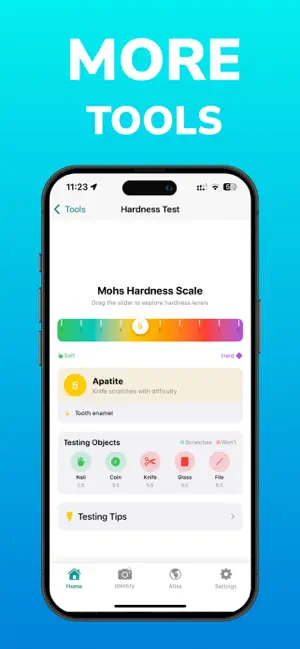
You need the specimen, good light, a hand lens or your phone camera's zoom, and the standard object kit: fingernail (2.5), copper coin (3.5), steel knife blade (5.5), a glass jar or scrap glass (5.5), and a steel file (6.5). These are the same five objects built into the Rockhound app's interactive Mohs tool, so you can follow along on screen.
- Pick a fresh test spot. Choose an unweathered face or chip off a small corner. Test an inconspicuous spot — a successful scratch is permanent.
- Start soft and work up. Press the fingernail firmly across the surface with a single deliberate stroke. No mark? Move to the coin, then the knife.
- Verify every apparent scratch. Rub the mark with your thumb and inspect with the lens. A real scratch is a groove that stays; a streak of metal or powder that wipes away means the specimen won, not the tool.
- Test both directions at the boundary. When the knife barely marks it, flip the test: drag the specimen's edge across glass. Scratches glass but not scratched by the file → hardness between 5.5 and 6.5. That two-way check is the heart of the method.
- Bracket and record. Write the result as a range ("scratched by file, scratches glass: 5.5–6.5"), not a single guess.

Rockhound: Rock Identifier — the built-in interactive Mohs hardness tool guides your scratch test with the same objects (fingernail 2.5, coin 3.5, knife 5.5, glass 5.5, file 6.5), and photo ID names the mineral in seconds. Free on iOS.
Download FreeInterpreting your results
Each bracket eliminates most of the mineral kingdom:
- Below 2.5 (fingernail scratches it): talc, gypsum, chlorite. Very short list.
- 2.5–3.5 (coin scratches it, fingernail doesn't): calcite, biotite, galena, gold. Add a vinegar fizz test to confirm calcite.
- 3.5–5.5 (knife scratches it, coin doesn't): fluorite, apatite, and many carbonates and phosphates.
- 5.5–6.5 (scratches glass; file scratches it): feldspar, pyrite, magnetite, hematite. Streak and magnetism separate these fast.
- Above 6.5 (scratches glass and file; nothing in the kit marks it): quartz, garnet, tourmaline, beryl, topaz, corundum. This is where most "is it a gemstone?" candidates live — our gemstone identification guide takes it from here.
Remember that hardness alone never names a mineral. It's one coordinate; combine it with streak, luster, and cleavage from our full mineral identification guide and the intersection is usually a single species.
Common mistakes that ruin the test
- Reading the tool's mark as a scratch. The classic error. Drag a copper coin over quartz and you'll see a bold line — it's copper smeared onto the harder quartz. Always wipe the mark: if it rubs off, the specimen is harder than the tool, not softer.
- Testing a weathered surface. Weathering rinds are chemically altered and always softer than the fresh mineral. A weathered feldspar can "test" at 3 when the fresh interior is a true 6. Break or chip to fresh material first.
- Testing a rock as if it were one mineral. A granite gives three different answers depending on whether you hit quartz, feldspar, or mica. If your specimen is multi-grained, identify the grains individually or start with our rock identification method.
- Scratching across grains or cracks. Test a solid, uniform area; a groove that follows a fracture proves nothing.
- Pressing timidly. A scratch test needs firm, confident pressure with a sharp edge or point. Light strokes produce false "no scratch" results on minerals near the tool's own hardness.
- Using coins and knives of unknown steel. Modern zinc-core pennies, plated coins, and hardened tactical blades stray from the classic values. A pre-1982 US copper cent is a true 3.5; ordinary stainless kitchen or pocket knives sit near 5.5.
Hardness of popular finds
The specimens people most often test, with their Mohs values:
| Find | Mohs hardness | Quick check |
|---|---|---|
| Quartz / amethyst / agate | 7 (agate ~6.5–7) | Scratches glass and file with ease |
| Calcite | 3 | Coin scratches it; fizzes in vinegar |
| Fluorite | 4 | Knife scratches it; often color-zoned cubes |
| Pyrite ("fool's gold") | 6–6.5 | Scratches glass; greenish-black streak |
| Gold | 2.5–3 | Soft — dents instead of shattering |
| Obsidian (volcanic glass) | ~5–5.5 | Conchoidal fracture; about the same as bottle glass |
| Garnet | 6.5–7.5 | Scratches glass; red dodecahedral crystals |
| Topaz | 8 | Scratches quartz |
| Ruby / sapphire (corundum) | 9 | Scratches topaz and everything below |
| Diamond | 10 | Scratches corundum; nothing scratches it |
| Turquoise | 5–6 | Knife barely marks good material |
| Jade (nephrite/jadeite) | 6–7 | Extremely tough; won't be scratched by a knife |
One caution for anything possibly gem-quality: don't scratch-test polished stones or crystal faces you care about. Test the back, the base, or a detached fragment — or skip the destructive test entirely and identify by photo first.
The scale in your pocket: Rockhound's Mohs tool
The Rockhound app builds this whole guide into an interactive tool. Open More Tools → Mohs Hardness Scale and it walks you through the test object by object — fingernail 2.5, coin 3.5, knife 5.5, glass 5.5, file 6.5 — narrowing the range as you report what scratched and what didn't. Because the app's database lists the exact Mohs hardness (plus streak, crystal system, and chemical formula) for thousands of minerals, your bracket converts instantly into a candidate shortlist.
In practice the fastest workflow runs both directions at once: photograph the specimen for an AI identification with a confidence score, then use the hardness tool to verify the answer physically. If the app proposes quartz and your file won't scratch the specimen, the ID holds. If the two disagree, request a geologist review from the results screen — a professional geologist confirms or corrects the identification within 24–48 hours with notes. And if the find came from the field, the app's atlas of 200,000+ collecting sites can tell you what's known to occur where you picked it up — a genuinely useful identification clue. New to collecting trips? Start with rockhounding for beginners.
Frequently asked questions
What is the Mohs hardness scale in simple terms?
It's a 1-to-10 ranking of how well minerals resist scratching, created by German mineralogist Friedrich Mohs in 1812. Each reference mineral scratches everything ranked below it: talc is 1 (softest), quartz is 7, diamond is 10 (hardest). You find a specimen's hardness by testing what scratches it and what it scratches.
How do I test rock hardness at home?
Use common objects with known hardness: a fingernail (2.5), a copper coin (3.5), a steel knife blade (5.5), a glass surface (5.5), and a steel file (6.5). Try to scratch a fresh spot on the specimen with each object from softest to hardest, and check whether the specimen scratches glass back. The specimen's hardness lies between the hardest thing that fails to scratch it and the softest thing that succeeds.
Is the Mohs scale linear?
No — it's ordinal, meaning it only ranks order, not amount. The absolute hardness gaps are wildly uneven: corundum (9) is about twice as hard as topaz (8) in absolute terms, while diamond (10) is roughly four times harder than corundum. A mineral at 6 is not 'twice as hard' as one at 3; it simply scratches it.
What hardness is quartz, and why does it matter?
Quartz is 7 on the Mohs scale — the benchmark of practical durability. It scratches glass and steel easily and nothing in an everyday pocket kit scratches it. Because quartz dust is everywhere in the environment, any gemstone softer than 7 will slowly dull with wear, which is why jewelers care about the 7 threshold.
Can a rock scratch glass and still not be quartz?
Yes. Anything harder than about 5.5 scratches glass, which includes feldspar (6), pyrite (6–6.5), garnet (6.5–7.5), topaz (8), and corundum (9). Scratching glass only proves hardness above 5.5 — combine it with a steel-file test (6.5), streak, luster, and cleavage to narrow the field.
Does the Rockhound app include a Mohs hardness tool?
Yes. Rockhound has a built-in interactive Mohs hardness tool that walks you through the scratch test with common objects — fingernail 2.5, coin 3.5, knife 5.5, glass 5.5, file 6.5 — and the app's database lists the Mohs hardness for thousands of minerals so you can check your result instantly. Free on iPhone and iPad.