The Complete Mineral Identification Guide
This mineral identification guide is the full reference: a complete Mohs hardness chart with household proxies, the streak test in depth, the luster taxonomy, cleavage versus fracture, all seven crystal systems, how to measure specific gravity at home, and a 15-mineral identification chart you can test any specimen against. If you just want the fast five-minute method, start with our companion guide, how to identify minerals — that one teaches the workflow; this one is the desk reference you come back to with test results in hand.
Bookmark the tables. Mineral identification is pattern matching: run the tests, then find the row where hardness, streak, luster, and cleavage all agree. When all four line up, you can be confident — when only color matches, you can't.
The Mohs hardness chart, 1–10
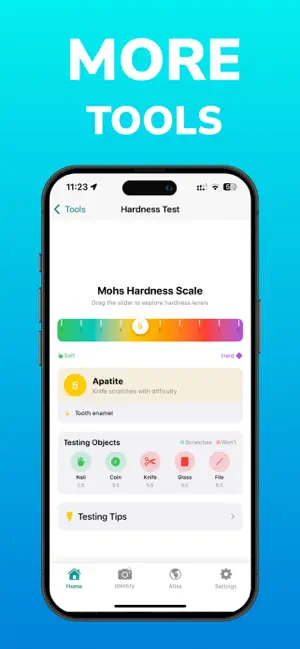
Hardness anchors every serious identification. Friedrich Mohs built the scale from ten reference minerals, each of which scratches everything below it. In the field you rarely carry reference minerals, so the household-proxy column is the one you'll actually use — bracket your specimen between the hardest thing that scratches it and the softest thing it scratches. For technique, common mistakes, and interpreting results, see our dedicated Mohs hardness scale guide.
| Mohs | Reference mineral | Household proxy | Field note |
|---|---|---|---|
| 1 | Talc | — | Greasy feel; crushes under a fingernail |
| 2 | Gypsum | Fingernail is ~2.5 | Fingernail scratches it |
| 3 | Calcite | Copper coin is ~3.5 | Coin scratches it; fingernail doesn't |
| 4 | Fluorite | — | Easily scratched by a knife |
| 5 | Apatite | Knife blade / glass ~5.5 | Knife barely scratches it |
| 6 | Orthoclase feldspar | Steel file is ~6.5 | Scratches glass with effort |
| 7 | Quartz | — | Scratches glass and a steel file easily |
| 8 | Topaz | — | Scratches quartz |
| 9 | Corundum | — | Ruby and sapphire; scratches topaz |
| 10 | Diamond | — | Scratches everything; nothing scratches it |
The streak test in depth
Streak is the color of a mineral in powdered form, and it's the most underused test in amateur identification. Surface color depends on trace impurities, weathering, and crystal size; powder color depends on the mineral's fundamental chemistry, so it barely varies from specimen to specimen.
The tool is a streak plate: a piece of unglazed porcelain, hardness about 6.5. A dedicated plate costs a few dollars, but the unglazed back of a ceramic bathroom tile or the unglazed rim on the bottom of a coffee mug works identically. Drag the specimen firmly across the plate for an inch or so, blow off loose grit, and read the powder color against the white background.
Two rules make streak decisive:
- Metallic minerals have dramatic, diagnostic streaks. Pyrite (brassy gold surface) streaks greenish black. Hematite (silver, black, or red surface) always streaks reddish brown. Magnetite streaks black. Chalcopyrite streaks greenish black. Galena streaks lead gray. Gold — the real thing — streaks golden yellow, which is how prospectors have unmasked fool's gold for centuries.
- Most nonmetallic minerals streak white or colorless regardless of body color: purple fluorite, pink calcite, and green apatite all streak white. A white streak doesn't identify the mineral, but a colored streak from a nonmetallic mineral is a strong clue (azurite streaks blue, malachite streaks pale green, sulfur streaks yellow).
If the mineral scratches the plate instead of powdering, it's harder than 6.5 — note that as the result and move on. Never force a streak from a prized crystal face; use the back or base of the specimen.
Luster: the full taxonomy
Luster is how a fresh surface reflects light, judged before any other test because it splits the mineral kingdom in two.
- Metallic — reflects like polished metal, opaque even on thin edges: pyrite, galena, magnetite, chalcopyrite.
- Submetallic — dulled metal look: some hematite, sphalerite.
- Vitreous — glassy; the most common nonmetallic luster: quartz, fluorite, calcite, garnet.
- Pearly — iridescent sheen on cleavage faces: mica, talc, some gypsum.
- Silky — fibrous sheen from parallel fibers: satin spar gypsum, asbestos.
- Greasy — looks coated in oil: nepheline, some massive quartz.
- Waxy — like a candle's surface: chalcedony, serpentine.
- Adamantine — brilliant, gem-like fire: diamond, cerussite.
- Dull / earthy — no reflection at all: kaolinite, limonite, chalk.
Weathered crusts can disguise luster completely — always judge on a freshly broken or unweathered face.
Cleavage planes vs. fracture types
How a mineral breaks reveals its internal atomic architecture. Cleavage is breakage along flat planes of weak atomic bonding, and it repeats: every break produces the same flat, light-reflecting faces. Describe cleavage by the number of directions and their quality:
- 1 direction (basal): mica peels into sheets; graphite too.
- 2 directions at ~90°: feldspar's blocky, step-faced fragments; pyroxenes.
- 2 directions not at 90°: amphiboles (~56°/124°).
- 3 directions at 90° (cubic): halite and galena break into little cubes.
- 3 directions not at 90° (rhombohedral): calcite's signature rhombs.
- 4 directions (octahedral): fluorite; corners cleave off cubes to form octahedra.
Fracture is any break that isn't cleavage, and its texture is diagnostic too: conchoidal (smooth, curved, shell-like — quartz, obsidian, flint), uneven or irregular (most minerals), splintery (fibrous minerals like serpentine), and hackly (jagged metal edges — native copper). The classic beginner's confusion is mistaking a flat crystal face for a cleavage face; cleavage repeats when you break the specimen again, crystal faces don't.
The seven crystal systems
Every crystalline mineral belongs to one of seven symmetry systems. You won't always see well-formed crystals, but when you do, the system narrows identification sharply — and it's one of the properties listed for every species in the Rockhound database.
| System | Symmetry shorthand | Typical forms | Example minerals |
|---|---|---|---|
| Cubic (isometric) | Three equal axes at 90° | Cubes, octahedra, dodecahedra | Halite, pyrite, fluorite, galena, garnet |
| Tetragonal | Two equal axes + one longer/shorter, all 90° | Square prisms, four-sided pyramids | Zircon, rutile, cassiterite |
| Hexagonal | Six-fold symmetry around one axis | Six-sided prisms | Beryl (emerald, aquamarine), apatite, graphite |
| Trigonal | Three-fold symmetry around one axis | Rhombohedra, three- or six-sided prisms | Quartz, calcite, corundum, tourmaline |
| Orthorhombic | Three unequal axes at 90° | Rectangular prisms, tablets | Topaz, olivine (peridot), barite, sulfur |
| Monoclinic | Three unequal axes, one oblique angle | Slanted prisms and blades | Gypsum, orthoclase, mica, azurite |
| Triclinic | Three unequal axes, no right angles | Low-symmetry blocky crystals | Plagioclase feldspar, kyanite, turquoise |
Some references fold trigonal into hexagonal for a six-system scheme; mineralogists (and the Rockhound database) treat them separately. For reading crystal shapes, terminations, and twinning in the field, see our crystal identification guide.

Rockhound: Rock Identifier — every mineral in the database lists the exact properties in these charts: Mohs hardness, crystal system, chemical formula, and more. Free on iOS.
Download FreeMeasuring specific gravity at home
Specific gravity (SG) — density relative to water — separates look-alikes that pass every other test the same way. You can measure it to useful precision with a kitchen scale:
- Weigh the dry specimen. Say it reads 54 g.
- Place a glass of water on the scale and zero (tare) it.
- Suspend the specimen from a thread so it's fully submerged but touching neither the bottom nor the sides. The scale now reads the weight of displaced water — say 20 g.
- Divide dry weight by displaced weight: 54 ÷ 20 = SG 2.7. That's dead-on for calcite or plagioclase; quartz would give ~2.65, barite ~4.5, galena ~7.5.
Porous or cracked specimens trap air and read low, and anything under about 20 g magnifies scale error — use the biggest clean fragment you have.
Mineral identification chart: 15 common minerals
Run your tests first, then find the row that matches. Hardness and streak are the sorting columns; luster and cleavage confirm; color is listed last for a reason.
| Mineral | Hardness | Streak | Luster | Cleavage / fracture | Common colors |
|---|---|---|---|---|---|
| Talc | 1 | White | Pearly to greasy | 1 perfect direction | White, gray, pale green |
| Gypsum | 2 | White | Vitreous to pearly, silky | 1 perfect direction | Colorless, white |
| Muscovite mica | 2–2.5 | White | Pearly | 1 perfect (thin elastic sheets) | Silvery, pale brown |
| Halite | 2.5 | White | Vitreous | 3 at 90° (cubic) | Colorless, white, orange |
| Biotite mica | 2.5–3 | White to gray | Pearly, submetallic | 1 perfect (thin sheets) | Black, dark brown |
| Calcite | 3 | White | Vitreous | 3 not at 90° (rhombohedral) | Colorless, white, honey |
| Fluorite | 4 | White | Vitreous | 4 (octahedral) | Purple, green, yellow, blue |
| Apatite | 5 | White | Vitreous | Poor; conchoidal fracture | Green, blue, brown |
| Hematite | 5–6 | Reddish brown | Metallic to earthy | None; uneven fracture | Steel gray, black, red |
| Magnetite | 5.5–6.5 | Black | Metallic to dull | None; uneven (magnetic!) | Black |
| Orthoclase feldspar | 6 | White | Vitreous | 2 at ~90° | Pink, cream, white |
| Pyrite | 6–6.5 | Greenish black | Metallic | None; uneven fracture | Brass yellow |
| Quartz | 7 | None (harder than plate) | Vitreous | None; conchoidal fracture | Clear, white, purple, pink, smoky |
| Garnet (almandine) | 6.5–7.5 | None (harder than plate) | Vitreous to resinous | None; conchoidal to uneven | Deep red, red-brown |
| Topaz | 8 | None (harder than plate) | Vitreous | 1 perfect (basal) | Colorless, blue, sherry yellow |
A worked example: your specimen scratches glass, won't streak, breaks with curved shell-like surfaces, and has a glassy luster. Reading the chart, only quartz fits all four — and its color (say, purple) then tells you the variety: amethyst. If a mystery specimen refuses to fit any row cleanly, it may be a rock rather than a single mineral; our rock identification guide covers that case, and What Rock Did I Find? walks through the most common mystery finds.
How the Rockhound database maps to this guide
Every property in the tables above is a field in the Rockhound app's mineral database, which covers thousands of species. Open any mineral and you'll find its Mohs hardness, crystal system and morphology, chemical formula and constituent elements, optical and mechanical properties, formation environments, and IMA status — whether the International Mineralogical Association recognizes it as an approved species, which matters when you're checking a trade name like "citrine" against the actual mineral (quartz).
That makes the workflow circular in the best way: photograph a specimen, let the AI propose a match with a confidence score, then check the proposed mineral's database entry against your own hardness, streak, and cleavage results from this guide. Agreement means a confident ID. Disagreement means either a re-test or — for specimens worth being sure about — a tap on the expert review option, which puts your photos in front of a professional geologist who responds within 24–48 hours with confirmation or correction and notes.

Once identified, specimens go into your in-app collection with your own notes, find locations, and multiple photos, backed up to the cloud. Over a season, that collection becomes your personal identification chart — the one calibrated to the minerals that actually occur where you hunt. If you're just getting started with field collecting, rockhounding for beginners covers the gear and the ground rules.
Rockhound: Rock Identifier — photo ID with confidence scores, a searchable database of thousands of minerals, and geologist verification in 24–48 hours. Free on iOS.
Download FreeFrequently asked questions
What is the best mineral identification chart for beginners?
A chart organized by hardness and streak, like the 15-mineral table in this guide. Test hardness first with household objects (fingernail 2.5, coin 3.5, knife 5.5, file 6.5), then streak on unglazed porcelain, and read down the chart to the minerals that match both. Color columns are supporting evidence only.
What are the 7 crystal systems?
Cubic (isometric), tetragonal, hexagonal, trigonal, orthorhombic, monoclinic, and triclinic. Every crystalline mineral belongs to exactly one system based on the symmetry of its internal atomic lattice. Examples: halite and pyrite are cubic, zircon is tetragonal, beryl is hexagonal, quartz is trigonal, topaz is orthorhombic, gypsum is monoclinic, and plagioclase feldspar is triclinic.
How do I measure specific gravity at home?
Weigh the specimen dry on a kitchen scale, then suspend it from thread fully submerged in a container of water sitting on the scale (without touching the sides) and note the added weight, which equals the water displaced. Specific gravity equals dry weight divided by displaced-water weight. Quartz gives about 2.65, magnetite about 5.2, galena about 7.5.
What does streak tell you that color doesn't?
Streak is the color of the mineral's finely powdered form, which stays constant even when the specimen's surface color varies wildly. Hematite can appear silver, black, or red, but its streak is always reddish brown. Streak is especially decisive for metallic minerals: pyrite streaks greenish black, gold streaks golden yellow, chalcopyrite streaks greenish black.
Can an app really identify minerals accurately?
Modern photo identification is a strong first pass: Rockhound's AI matches specimens against thousands of minerals and reports a confidence score, plus the hardness, streak, cleavage, and crystal system you need to verify the match yourself. For high-stakes specimens, the app can send your identification to a professional geologist who confirms or corrects it within 24–48 hours.
Why won't some minerals leave a streak on a porcelain plate?
Unglazed porcelain has a hardness of about 6.5, so minerals harder than that — quartz (7), topaz (8), corundum (9) — scratch the plate instead of powdering. A 'no streak' result is itself diagnostic: it tells you the mineral is harder than 6.5, which immediately rules out most common species.